

Developing the first stonefang Paint Brush
Over the past several months, I’ve been working on one of the first physical hobby products for Stonefang: a paint brush designed specifically with miniature painters in mind.
The idea started from my own painting experience.
I’ve always enjoyed painting with Kolinsky sable brushes. They hold paint well, keep a fine point and have a responsiveness that makes them particularly suited to miniature painting. The problem is the price. A good natural sable brush can become an expensive piece of equipment, particularly when it is also being used for everyday painting rather than reserved purely for fine detail work.
I wanted to see if I could create something that captured some of the qualities I liked about sable, but in a synthetic brush at a much more approachable price.
Material, Bristle Length, Handle Shape
Lots of variables are required to be considered make for a great brush.
Finding the Right Brush
One of the brushes I kept coming back to as a reference was the Raphael 8404.
It is a very well-known brush among miniature painters, particularly because of its combination of a relatively generous belly, long fibres and fine working point. Rather than simply looking for the smallest or sharpest brush possible, I wanted something that could perform two jobs.
It needed to be a workhorse brush capable of handling the majority of normal miniature painting, while still giving enough control at the tip for finer details.
That led to quite a bit of testing.
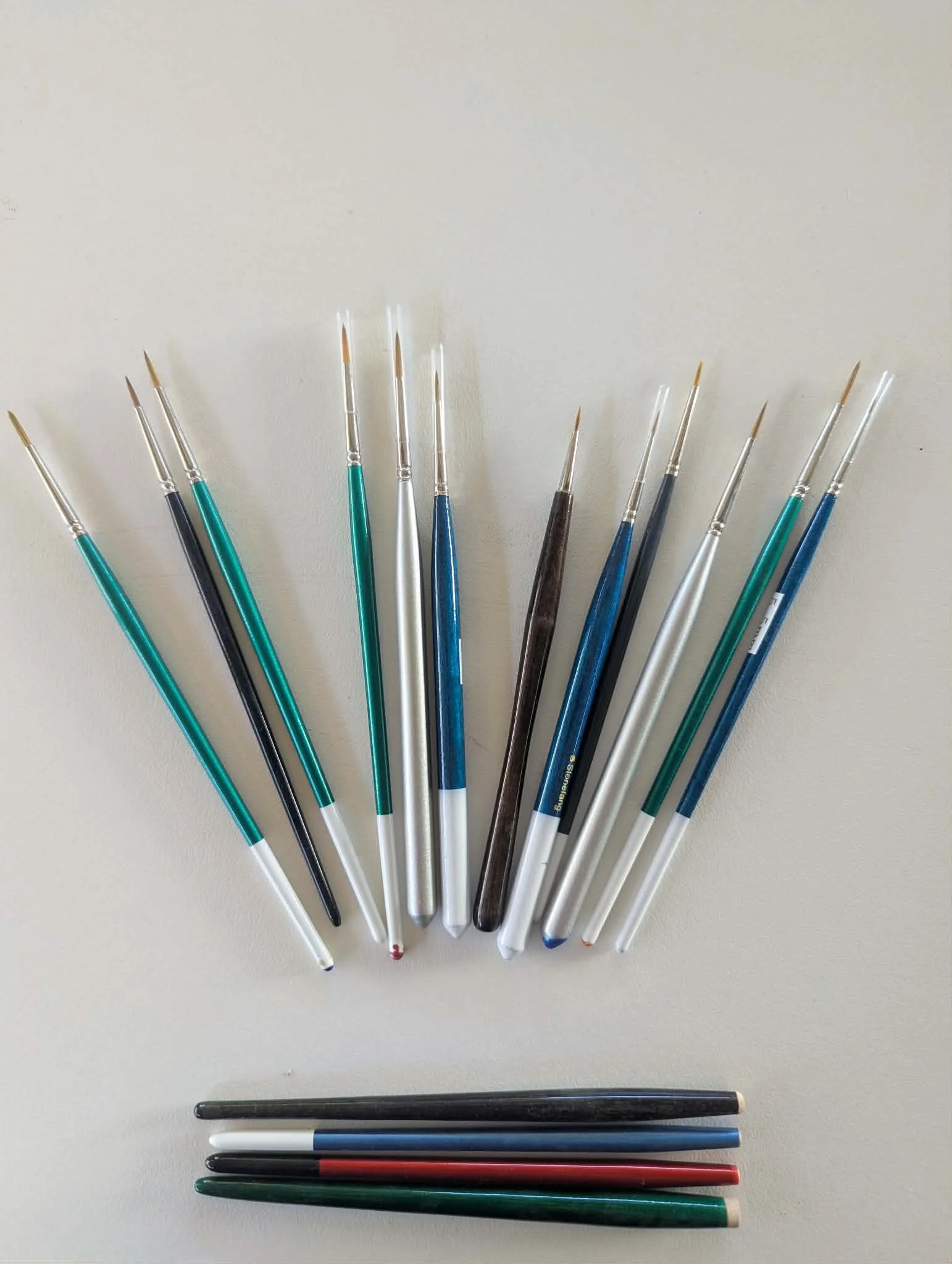
I tried roughly 20 different brushes, sourcing samples from manufacturers across Europe, Vietnam and Japan. There were different fibre types, shapes, lengths and handle designs, and the differences between them became surprisingly noticeable once I started actually painting with them.
Eventually, one particular Size 1 synthetic Taklon brush stood out, made from a brand new Taklon fibre that was a vast improvement from my initial expectation of Taklon.
Why Size 1?
For the first Stonefang brush, I decided to concentrate on a single size rather than immediately producing a complete range.
The Size 1 I selected has the balance I was looking for between the belly of the brush, the length of the fibres and the point.
The larger belly allows it to carry enough paint that you aren't constantly returning to the palette, while the point means it can still handle considerably finer work than its size might suggest.
That versatility is particularly important to me.
I don't want this to be a brush that only comes out when you're painting an eye or highlighting a tiny edge. The goal is for it to be the brush sitting in your hand for a large portion of the miniature.
Basecoating smaller areas, layering, glazing, highlights and detail work should all be possible without constantly swapping brushes.
Giving the Brush Its Own Identity
The physical brush was only part of the project.
I also wanted the packaging to feel distinctly Stonefang rather than looking like another generic hobby tool.
For the artwork, I worked with Yakku Art, who created a Japanese-inspired packaging design centred around a huge Inari shrine rendered in vibrant pink and white.
The brush itself went through several possible handle colours before I eventually settled on blue.
Together, the packaging and brush are intended to feel like part of the wider Stonefang identity I'm developing across the miniature, tabletop and hobby side of the business.

Final Packaging Design
Launching in October
The first Stonefang Size 1 brush is currently planned for release in mid-October.
I've spent months sampling, painting and narrowing down the design to a brush that I personally enjoy using. Now the important part is finding out whether other miniature painters feel the same way.
If the first 500 brushes prove themselves, there will be plenty of room to expand from there.
But for now, it starts with one brush.
Stonefang Size 1 — launching October 2026.
